Rethinking Business: The Shift from Self-Employment to System Building
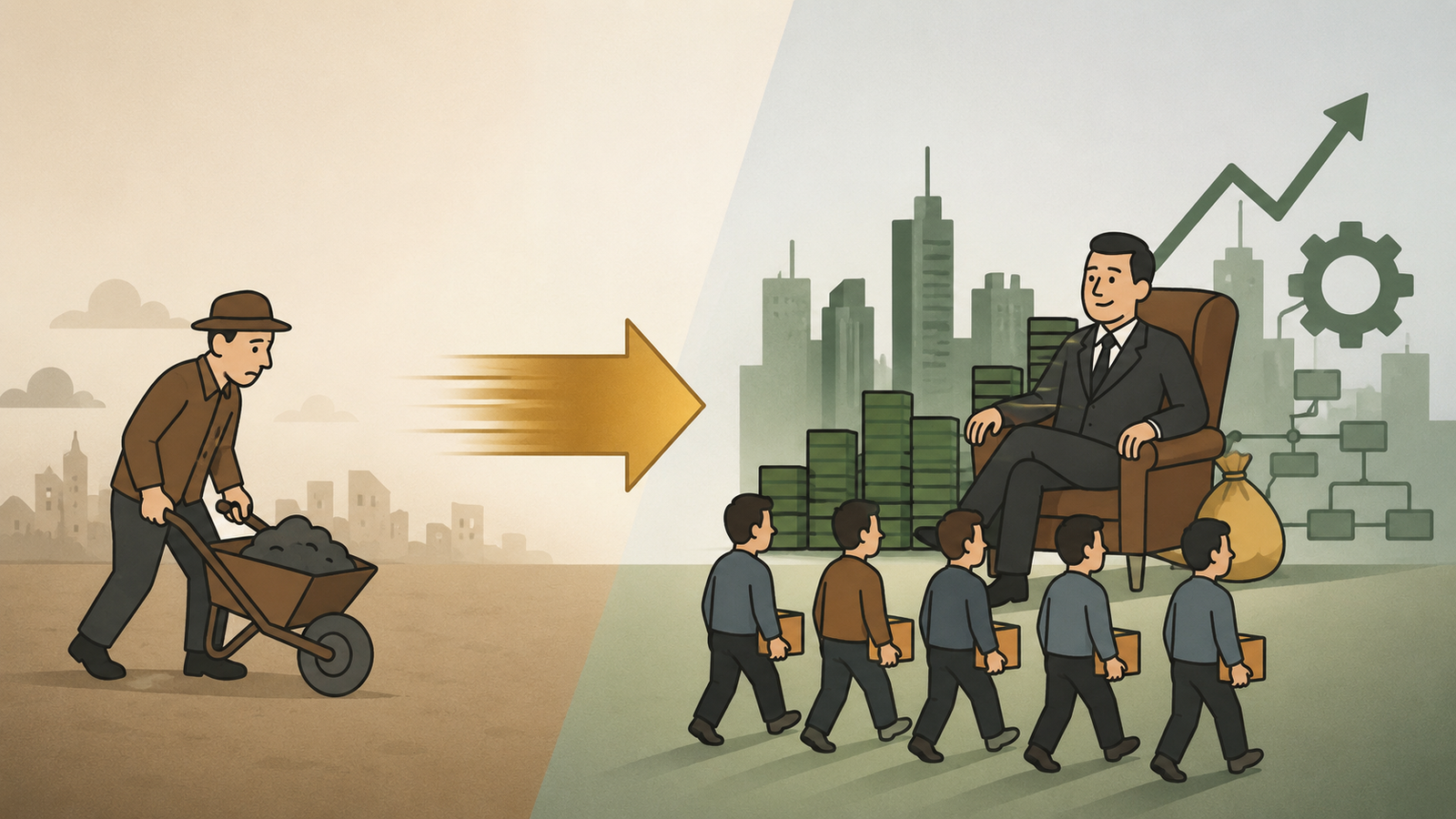
The Laborer Trap: Why Most 'Business Owners' Are Just Working a Grueling Full-Time Job
Imagine strolling on your local high street. There’s a shop keeper who owns the local corner shop. He’s always the first to arrive and the last to leave. He’s the one who arrives at 6am to open the shutters and the one who diligently sweeps the floor at 10pm. He’s also the one who calls himself an entrepreneur - and society cheers him for it. But is he really?
There are millions of people out there just like him. People who strive to attain financial freedom by any means necessary but end up as glorified employees on their own payroll. In this article, I’m going to discuss the nuances of entrepreneurship and the mindset shift you need to make to truly create wealth.
First things first,
society has the wrong definition of entrepreneurship. We wrongly consider self-employment as entrepreneurship. If you work 80-hour weeks, lifting bags, dealing with customers’ drama, and making all the important decisions yourself - you are not an entrepreneur. You are a glorified employee in your own establishment.
If you’re in the same boat as most people - you’re actually a slave to your own business.
You know you’re right where you are because if you take a day off, your income grinds to a halt - and if you catch a cold, it’s back to square one. Instead of having created a beach or ski vacation for yourself for the price of a local wage, you’ve built a gilded cage that you cannot escape. What separates a self-appointed entrepreneur with a self-inflicted 80-hour workweek from someone like me or any successful manager is that they still do not have a business. They have a job, only they are their own boss.
The main difference between someone who has their own job and someone who owns a business is that the latter has systems in place.
A business is a set of systems designed to help make money, even when the owner is unavailable. A competent team of professionals runs those systems and is not reliant on the constant involvement or presence of the proprietor. When you start realizing that you need to think of yourself as an architect and not as a laborer, and you need to start designing systems that solve problems for people, you will begin to think of yourself as a true entrepreneur. Architects do not build buildings themselves. They design them so that others can erect them with little or no involvement from themselves. Similarly, successful entrepreneurs design systems that make money even when they are not involved.
The biggest names in companies are usually not on the front lines.
Even the busiest among them do not personally go to the shop floor or the production belts. For instance, Amul’s founders are not on the production lines in Gujarat wrapping butter. They created the systems and the infrastructure and now the cows do the hard work for them. This is what billionaires such as Mukesh Ambani (the founder of Reliance Industries) do for a living. The man does not personally pour fuel into any gas station - yet he is richer than most people will ever dream to be in their entire lives.
Now, I want to be clear that every single successful entrepreneur was once where you are. When you start, it is normal to be doing 10 things at once. You are your own staff - a competent but busy person who may do tasks that you would hire somebody else to do if you had the money. The difference between you and me is that I know I am my own worst enemy. I realized early on in my entrepreneurial endeavors that I need to create competent systems that can take over specific areas of my business so that I can move on to scaling and growing my business further. If you are truly serious about learning how to become an entrepreneur, think not of what you can do but rather what systems can do for you. Start by asking yourself how much time you spend doing actual work versus how much time you spend managing people. You want to look at the tasks that can eventually be delegated to others and start writing down the processes. Then you can hire people to carry out some of these tasks for you.
So, the next time someone takes pride in telling you that they are an entrepreneur, remind them that as long as they have to work 80-hour weeks to maintain their so-called business, they are merely self-employed. The key to creating wealth is that your income should be largely impervious to your involvement or availability. The best way to achieve this is to build competent systems to solve problems, make money, and grow your business while you are away.